
Rest & Reset
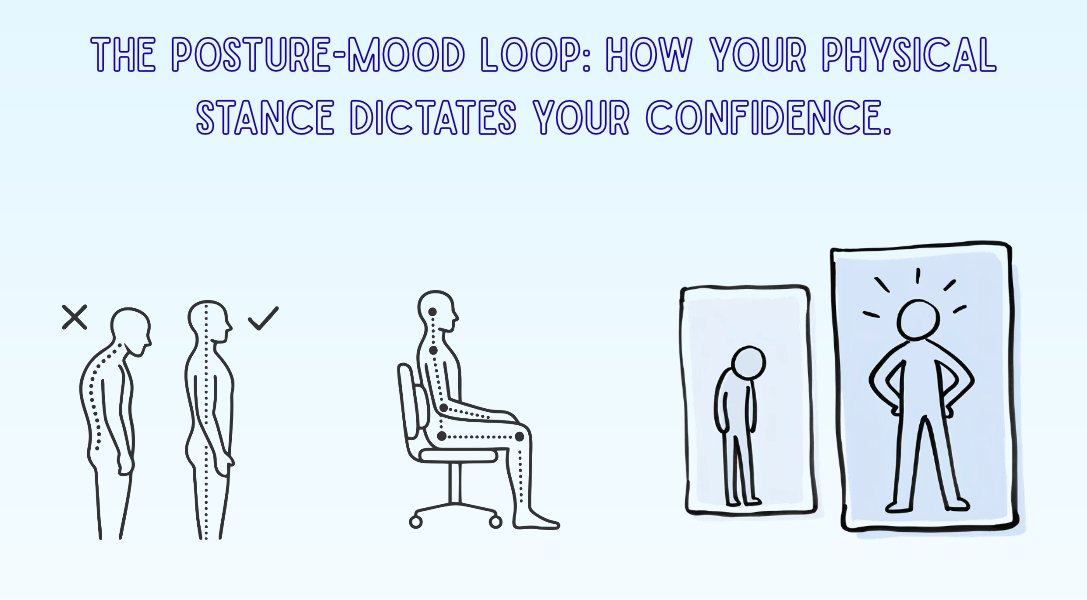
Pause for just a moment and notice your body. Without judgement, just observe:
- What are your shoulders doing? Are they creeping toward your ears?
- Where is your head? Is your neck tight because your head is in a forward position?
- What is your core doing? Is it slouched, or engaged?
- What is your jaw doing. Relaxing or clenched?
Take the next 30-60 seconds to align and relax your body. Your whole being will thank you! Assuming you are sitting, follow these steps to give your overworked muscles a break.
Starting with the foundation:
- Uncross your legs or ankles if they are crossed.
- Find your sit bones: rock side to side until you feel the two hard bones at the base of your pelvis firmly anchoring you into the chair.
- Neutral pelvis: Do not let your lower back slump backward into a “C” shape, and do not aggressively arch your lower back forward. Aim for a neutral pelvis where your weight sits directly on top of those bones.
Moving on to the core:
- Ribcage over Pelvis: Imagine your ribcage is a bowl stacked directly over the bowl of your pelvis.
- Stack the Shoulders: Imagine your shoulders are stacked without effort, just resting on top of your rib cage.
- Axial Elongation: Imagine a string attached to the very top and back of your head gently pulling you toward the ceiling. This naturally creates space between your vertebrae without forcing a rigid posture.
Moving upward and releasing tension:
- The Shoulder Drop: Shrug your shoulders all the way up to your ears, roll them back, and let them drop down completely. Your shoulder blades should feel heavy, like they are sliding down into your back pockets.
- The 90-Degree Rule: Keep your elbows bent at roughly a 90-to-100-degree angle, relaxed by your sides. If typing, your forearms should parallel the floor.
- Head and Jaw Neutrality: Bring your chin slightly back (like making a very subtle double chin) to align your ears directly over your shoulders. Part your teeth slightly to instantly un-clench your jaw. If your tongue is firmly pressed against the roof of your mouth, let it relax.
Breathe
Now take a deep breath in for 4-5 seconds and exhale for 6-8 seconds. Notice that shift? In less than a minute aligning your body and releasing that physical grip likely brought a calming wave, a quieting of the mind, space to breathe deeper, or a noticeable drop in tension. This simple exercise demonstrates how your posture affects your mood.
Now that you’ve felt it, let’s go a little deeper to understand how our posture has such a significant impact on our mental health and mood.
The Mind-Body Feedback Loop
Our bodies are equipped with a mind-body feedback loop. Your brain continuously reads physical cues from your body. When you stand or sit tall, your nervous system interprets the stance as safety and capability, raising feelings of pride, alertness, and self-assurance. According to ReachLink, “When you adopt an upright, open posture, your body sends feedback signals through your nervous system to your brain. These signals influence regions involved in emotional processing, stress response, and self-perception. Your brain essentially reads your body’s position as data about your current situation and adjusts your psychological state accordingly.” (ReachLink, 2026)
In contrast, when we slouch, our body sends a stress signal. Collapsing your chest compresses your lungs and diaphragm. This forces shallow chest breathing, which signals stress to your central nervous system, elevates tension, and triggers negative or fearful thoughts.
Our posture even impacts our memory and cognition. Research shows that posture influences memory recall. Slumping makes it easier for your brain to retrieve self-doubting or negative memories, whereas an open posture supports positive emotional recall and mental clarity. (Egoscue, 2026) So, the next time you’re stuck in a negative thought pattern, check your posture, adjust, and breathe.
Posture & Pain
Poor posture can also result in temporary or even chronic pain in the body, which in turn may impact our mood and confidence. If you have pain and you know your posture needs some work, try implementing the “30-minute movement rule.” Set a timer to change positions or gently stretch every 30 minutes and reset your alignment. If you have been dealing with chronic pain muscle pain or tension, consider working with a physical therapist who can assess and treat your specific needs.
Make a change today
We often think we need a big plan to make recognizable changes in our body, so we may avoid any change at all. Posture is one of the simplest and best places to start. Set a timer. If 30 minutes is not reasonable in your day, start with every 2 hours. When the timer goes off, notice your posture, make adjustments as needed, and take a few focused breaths in that posture. No weights, no equipment, no special location needed. Try it for a week or so and see if you what notice!
Note: If you are standing most of the day, you may want to find a free video online that demonstrates correct standing posture before setting your timer.
References:
ReachLink. (2026, April 8). Posture and confidence: How your body affects self-belief. ReachLink Advice. https://www.reachlink.com/advice/body-language/posture-and-confidence/
No responses yet